
The school holidays always begin the same way in our house. Cupboards emptied, shelves sorted, outgrown clothes and old toys donated. My children are edging from little people into teenagers, and every holiday seems to mark another quiet transition.
This week, buried at the back of a cupboard, I found something I hadn’t seen in years.
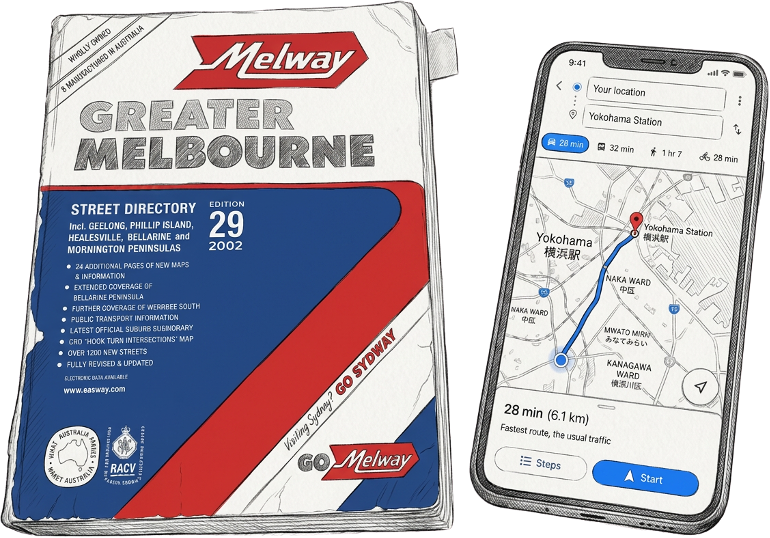
A Melway.
If you grew up in Melbourne, you’ll smile at that. Before smartphones and Google Maps, the Melway (2002) was the street directory. The night before driving somewhere unfamiliar, I’d spread it across the kitchen table, trace the roads with my finger, and memorise street names, hoping I’d remember enough to arrive. Miss a turn, and I’d pull over, balance the enormous book on the passenger seat, and work out where I was before carrying on.
I don’t miss getting lost. But there was a small ritual to it I hadn’t realised I’d remember, the book spread open on the table, the planning the night before, the folded corner that always marked home.
Twenty years later, wandering through the streets of Yokohama, I barely thought about navigation at all. Google Maps ran in the background, recalculating when I changed direction, comparing train and walking routes, suggesting a café when I felt like stopping. I was still choosing where to go. But getting lost no longer felt like something to avoid. It became part of the journey, absorbed by the system.
GPS never removed the journey. It changed the conditions under which the journey happened. I became more willing to wander, to change my plans, to explore places I might once have avoided. My curiosity hadn’t changed. The environment around it had.
Technologies don’t simply change what we do. They change the conditions under which we do it.
The Shift
AI feels like another version of that same shift. Not because it’s the same as GPS, but because it’s changing the background conditions of work, decision-making and learning. We can already see that shift beginning to appear. Just this week, Google introduced Study Mode in Gemini. Instead of simply answering questions, it reads a student’s notes, textbooks and course materials, builds an understanding of what they’re trying to learn, teaches concepts one step at a time, diagnoses gaps in understanding, quizzes them, offers hints rather than immediate answers, and adapts as learning progresses. It is a subtle but important shift. AI is moving beyond being an answer engine towards becoming a learning companion. One feature caught my attention. After reading your notes, textbooks or research papers, Gemini doesn’t simply start teaching. It first generates a diagnostic assessment to identify what you already understand and, more importantly, what you don’t. Learning begins at the point of need rather than at page one. For centuries, education has largely been organised around delivering the same sequence of content to everyone. Intelligent tutoring systems are beginning to invert that logic. The starting point is no longer the curriculum; it is the learner!
This isn’t only relevant for school students. The same capability can help a doctor learn new clinical guidance, a lawyer navigate changing legislation, a teacher studying cognitive science, or a leader trying to understand a new strategic framework. Dense manuals, research papers and professional learning can become interactive conversations rather than static documents.
Whether tools like these ultimately deepen understanding or create new dependencies remains an open question. But they illustrate something important: the technology is no longer only changing how quickly we access information. It is beginning to change the conditions under which people learn.
Across almost every profession, it’s becoming part of the operating system, drafting documents, analysing data, writing code, summarising meetings, and increasingly working through agents that complete whole workflows rather than isolated tasks.
In business, the conversation has already moved. It’s no longer “Should we use AI?” but “How should we redesign work now that AI can do this?” The most forward-thinking organisations aren’t asking how AI fits into their existing workflows. They’re asking what work should remain deeply human, what intelligent systems can support, and what becomes possible when people reclaim a little time, attention and cognitive capacity.
A few months ago, much of the discussion centred on prompt engineering, learning how to ask AI better questions. Today, the conversation has shifted again. People are now talking about loop engineering: designing the conditions under which autonomous agents operate successfully. The work is no longer about writing the perfect prompt. It is defining what success looks like, establishing guardrails, deciding when humans should intervene, determining what tools an agent can access, and designing the feedback loops that allow the system to monitor itself without drifting off course.
In other words, the leverage has moved again. We are spending less time directing intelligent systems and more time designing the systems within which intelligence operates.
Education, though, seems to be having a different conversation.
The conversation we tend to have
Spend five minutes scrolling, and a familiar narrative appears. AI is destroying critical thinking. Students won’t learn to write. They’ll become dependent. They’ll cheat. Teachers will become obsolete. These are legitimate concerns, and they deserve thoughtful discussion; every significant technological shift asks us to think carefully about ethics, unintended consequences, and the values we choose to protect.
I feel the pull of both sides. I’m not a technology evangelist, and I’m wary of anyone who promises a tool will fix teaching. The worry is real, not imagined. But I’ve also come to think it sends us looking in the wrong place.
Behaviour is rarely where a system changes
One of the central ideas in systems thinking is that behaviour is rarely the best place to intervene. Peter Senge argues that the greatest leverage for change comes not from trying to change what people do, but from changing the structures that shape it. Donella Meadows made a similar observation: systems behave the way they do because of how information flows, where feedback happens, what constraints exist, and what assumptions they were built upon.
Looking back, GPS makes much more sense through that lens. It didn’t make me adventurous. It changed the structure surrounding navigation. Information became immediate rather than static. Feedback became continuous rather than delayed. Wrong turns carried almost no cost because the system recalculated in real time. My behaviour changed because the conditions around it changed.
So instead of asking whether AI is making students think less, perhaps we might ask a different question. Is it changing the structure surrounding learning itself? Information is becoming immediate rather than scarce. Feedback has the potential to become continuous rather than delayed. And support no longer depends entirely on whether a teacher happens to be standing beside one particular student at one particular moment. Teacher time, so long swallowed by planning, marking and administration, might instead be spent on coaching, on relationships, on the kind of judgement that’s hard to automate.
Questions that were never really about technology
Seen this way, the questions facing education begin to change. They have never really been questions about technology. They’re design questions. How do we personalise learning for thirty students with thirty different starting points? How do we provide feedback quickly enough for it to shape learning? How do we challenge students who are ready to accelerate while supporting those who need more time, without creating impossible workloads for teachers?
These are some of education’s oldest questions. What may be changing is not the questions themselves, but the conditions under which we attempt to answer them.
I see that most clearly in something teachers tell me again and again: that they’ve stopped believing there’s much point in correcting the weekly homework books. Not from any lack of care, but because by the time a child gets the book back, a week later, they’ve moved on and rarely look again. Effective feedback is meant to be timely, specific and relevant, yet a comment written on a Friday and handed back the following Thursday fails the first test before it ever has a chance. The problem was never the teacher’s diligence. It was the conditions around it.
What becomes possible depends on the conditions we create
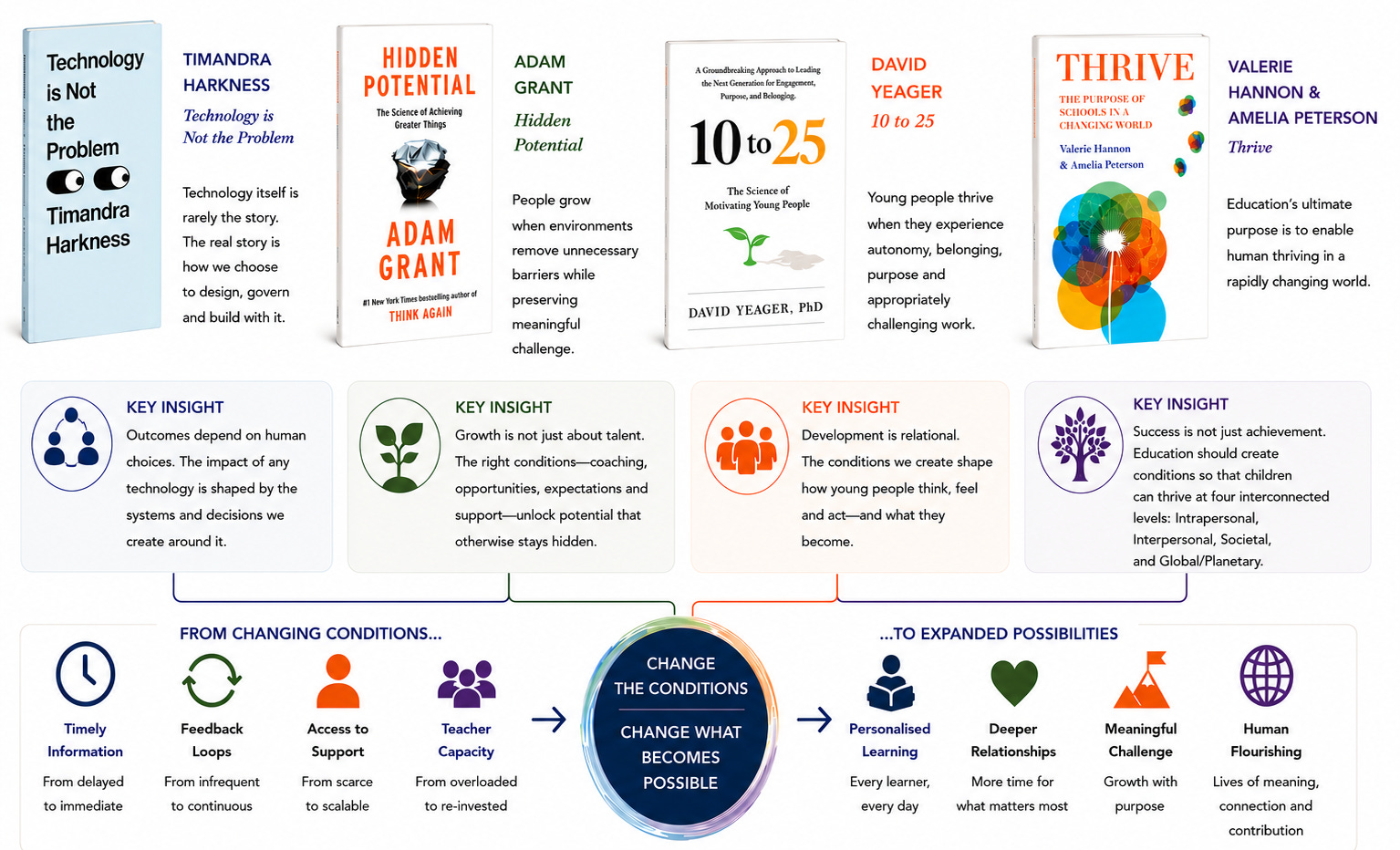
And it isn’t only me arriving at this. Over the past few months, I’ve been reading across an unusually broad collection of books: Timandra Harkness on technology and society, Adam Grant on hidden potential, David Yeager on adolescence, and Valerie Hannon and Amelia Peterson on what school is ultimately for. On the surface, they seemed to have very little in common. Yet, they are all, in their own way, writing about systems, about the environments that allow people to thrive.
From a Two Sigma Problem to a Two Sigma Opportunity
Like many educators, I had always thought of Bloom’s Two Sigma Problem as research about tutoring. Reading it again through a systems lens, I realised it was really research about constraints. Bloom had shown that personalised tutoring dramatically improved learning; the average tutored student outperformed about 98% of those in a conventional classroom. Proving that tutoring worked was never the hard part. The hard part was that no school could provide one expert tutor for every learner.
Perhaps the limitation was never pedagogical. It was structural.
That is why Sal Khan frames AI and Khanmigo, Khan Academy’s tutor, as an opportunity to give every student an intelligent tutor and every teacher an intelligent teaching assistant, turning Bloom’s Two Sigma Problem into a Two Sigma Opportunity. Whether that vision becomes reality remains to be seen. But if one of education’s greatest historical constraints begins to shift, what else might become possible?
Schools were built around scarcity
For generations, many school structures made sense because they were designed around real constraints: one teacher, many students, limited time, delayed feedback and uneven access to support. Whole-class instruction, fixed pacing, homework, assessment cycles and reporting schedules were practical responses to those conditions. But if some of those conditions are beginning to shift, then which assumptions still serve learning, and which were built around constraints that are starting to change?
If the conditions change, perhaps some of those assumptions deserve to change with them. This doesn’t mean abandoning what matters. It means asking questions about what should endure, what should evolve, and what might now be possible. Schools like Alpha interest me for this reason, not because they have necessarily found the answer, and not because every school should become them, but because their founder, MacKenzie Price and her team are asking a different kind of question. They aren’t simply adding AI to the existing model of school. They’re exploring what school might look like if feedback, pacing, tutoring and support were designed from the beginning.
That, I think, is the conversation education is being invited into. Not “Should we use AI?” but: which of our assumptions were intelligent responses to yesterday’s conditions and may no longer serve tomorrow’s learners?
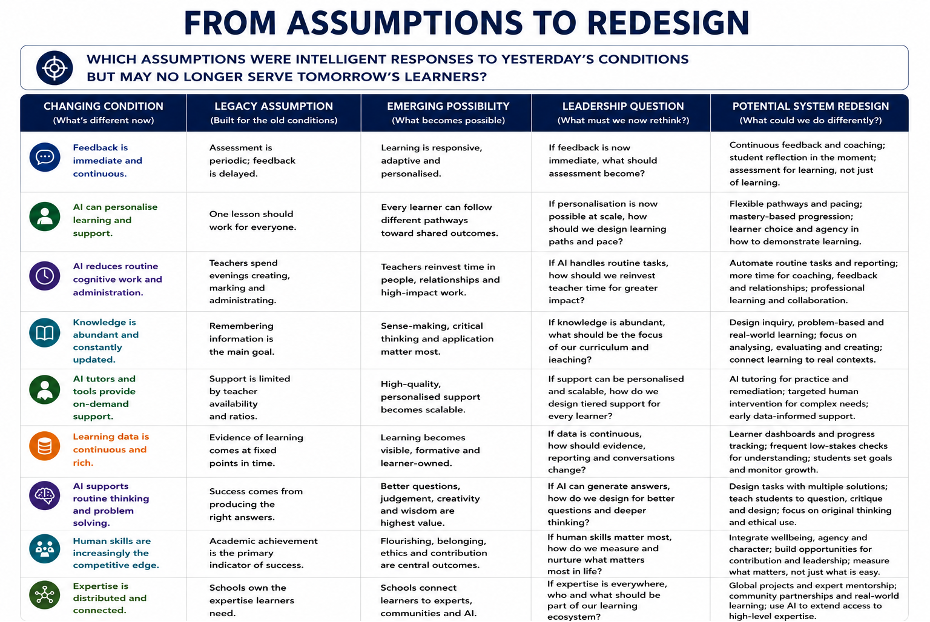
It’s worth being honest that systems rarely behave in predictable ways. Change one condition, and consequences often appear elsewhere. Immediate feedback may improve learning while increasing dependence. Personalisation may increase engagement while reducing opportunities for collective struggle. Redesign is always experimental; every change creates new dynamics that need observation, adjustment and learning. The framework above isn’t a roadmap or a prescription. It’s simply a way to begin the conversation: start with the changing condition, name the legacy assumption beneath it, then ask what new possibility is emerging and what kind of redesign might be worth exploring.
And it helps to be clear about what doesn’t change. Schools are not simply information systems; they are communities of people, relationships, values, histories and cultures. Young people will still need trusted adults. They’ll still need opportunities to struggle, collaborate, belong, create and discover who they are becoming. AI may change many of the conditions surrounding learning, but it does not change why schools exist. If anything, it makes that question more important.
As I put the old Melway back on the shelf, I realised it had become more than a reminder of how we once travelled. We didn’t abandon paper maps because they were wrong. We moved beyond them because the conditions changed, and our behaviour changed with them.
Perhaps education is approaching a similar moment. When the conditions change, new possibilities emerge. Whether those possibilities become reality depends on the decisions we make next: our courage to question old assumptions, our willingness to try new ways of learning, and our care in protecting what still matters most.
References
Bloom, B. S. (1984). The 2 sigma problem: The search for methods of group instruction as effective as one-to-one tutoring. Educational Researcher, 13(6), 4–16.
Grant, A. (2023). Hidden potential: The science of achieving greater things. Viking.
Hannon, V., & Peterson, A. (2021). Thrive: The purpose of schools in a changing world (2nd ed.). Cambridge University Press.
Harkness, T. (2024). Technology is not the problem. HarperNorth.
Khan, S. (2024). Brave new words: How AI will revolutionize education (and why that’s a good thing). Viking.
Meadows, D. H. (2008). Thinking in systems: A primer (D. Wright, Ed.). Chelsea Green Publishing.
Senge, P. M. (2006). The fifth discipline: The art and practice of the learning organization (Rev. ed.). Currency.
Yeager, D. S. (2024). 10 to 25: The science of motivating young people. Avid Reader Press.