
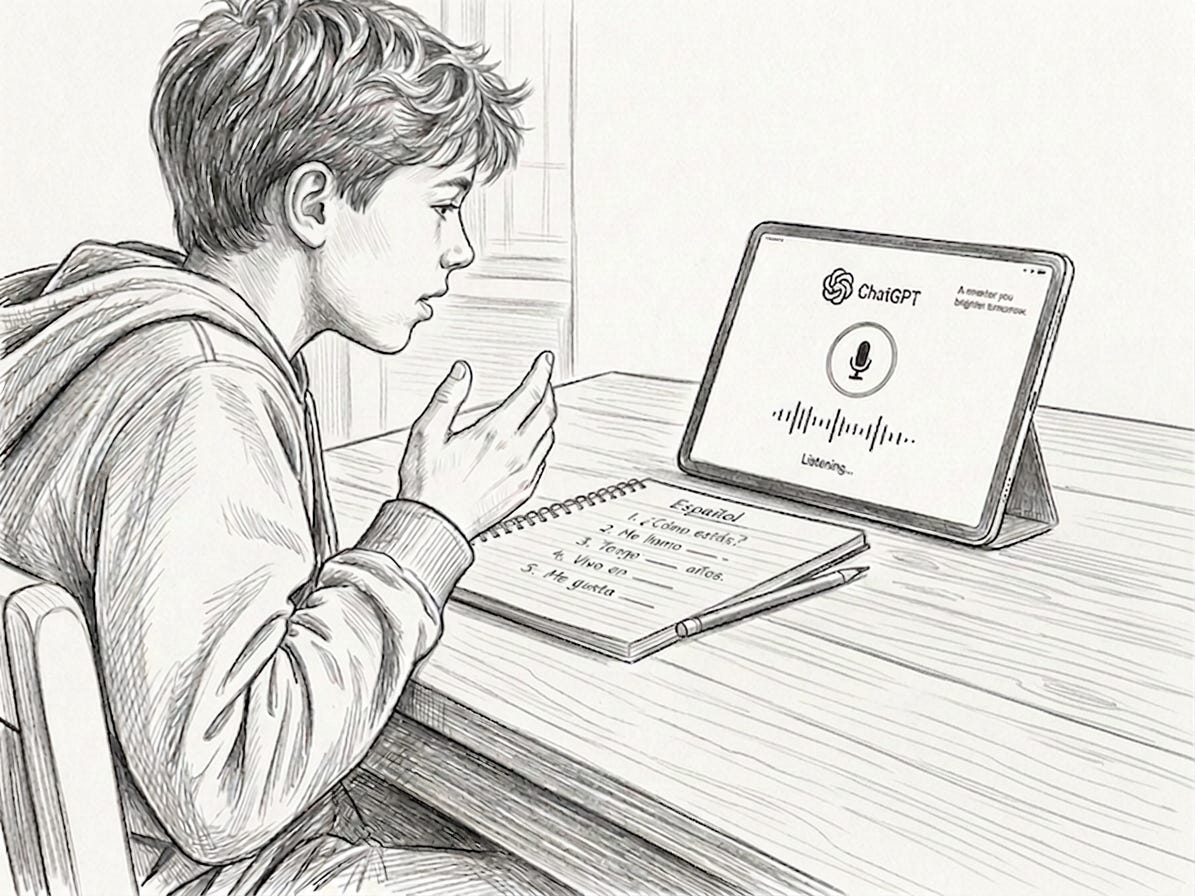
My son (11 years old) had Spanish homework, and I was trying to help. I don’t speak Spanish, so I couldn’t explain why an answer was right or tell him how the words should sound.
Finding a tutor is a familiar option here in Shanghai. But I didn’t have time, so this morning we opened ChatGPT’s voice conversation and had a go together. Of course, he started by asking ChatGPT for the answers. To my son, there was homework to finish on the weekend, and here was something that could help him finish it. I get it!
Before we went any further, I told him, “I want you to use this conversation to learn and remember how to pronounce the words and how to respond. That’s the goal, so tell ChatGPT that first. Then tell it what you need it to do to help you get there.”
We began with:
“I’m practising Spanish. I want to remember the pronunciation and be able to answer questions on my own. Ask me one question at a time and wait for my answer. Give me feedback on my pronunciation, model how it should sound and let me try again. If I get stuck, help me work it out.”
Then we asked it to keep the practice going towards that goal:
“Give me different situations using the language in my homework. Change the order of the questions, ask me follow-up questions and throw in a few curveballs. Keep helping me practise until I can pronounce the words and respond without a hint.”
I wanted him to realise he could keep shaping the conversation. If he needed to hear a word again, he could ask. If he was getting comfortable with the questions, he could ask for something harder or a different situation. I couldn’t help much with the Spanish, but I could show him how to ask for the practice he needed to learn!
The key was that he had to tell ChatGPT what he needed in order to learn successfully. He needed to know what he was aiming for, notice what he was finding difficult and ask for the right kind of help. Those are metacognitive skills, and they need to be taught explicitly.
My son knew he could ask for an answer. My role was to show him how to ask for the kind of help that would actually help him learn.
It took me back to studying Maths Methods in my final years of high school. I remember struggling and finding it difficult to get help when I needed it. Teachers had limited time outside class, and hiring a private tutor wasn’t really part of the culture around me. Looking back, I wonder how different that experience might have been with an AI companion I could turn to when I was stuck, ask to explain something another way, or work through an example with me. I already wanted to learn. I just needed more help making sense of it.
Now my son can ask for help when he gets stuck. I love that.
Getting help quickly is not, by itself, the goal. Struggle matters in learning, but only when it is productive.
The important question is whether the learner can recognise why they are stuck, decide what kind of help they need, try a strategy, and then judge whether it has actually moved their learning forward.
That was the part he still needed me for this morning.
I was not really helping him with Spanish. I was helping him think about his own learning:
What don’t I understand yet? What should I ask? Do I need an explanation, an example, more practice, or feedback on my pronunciation? How will I know when I’ve improved?
And for those of you who love the research, this is underpinned by metacognition and self-regulated learning. Barry Zimmerman’s (2002) work describes learners as actively setting goals, selecting strategies, monitoring their performance and reflecting on what is working. These behaviours do not simply appear because a learner has access to information, or even access to an intelligent tutor. They need to be explicitly taught, modelled and practised.
Having access to intelligence does not automatically create an effective learner. Learners still need to develop the metacognitive capacity to direct that support, evaluate whether it is helping, and eventually know when they can continue without it.
Perhaps that is one of the most important roles we have as adults in an AI-rich world: not removing the struggle, but helping young people learn how to manage it. The aim is not for AI to think for them. It is for them to become increasingly aware of how they think, how they learn, when they need help, and what to do next.
I can see how useful this could be in a classroom, too. With twenty-plus children, you can’t give everyone individual attention at once. While a teacher is helping one child, another could be rehearsing a conversation or working through an example with AI. That practice would need to be planned, and the feedback checked, but the extra opportunity to ask questions and try again is something I find exciting.
Of course, I’d worry if all we checked was whether the homework was finished.
A page of correct answers doesn’t tell us much if the child has copied them.
We need to know whether they can explain what they’ve done and have a go at something similar themselves.
If you’re a parent wondering where to start, I’d keep it small. Sit together for ten minutes and agree on what your child wants to be able to do. Help them explain that goal to ChatGPT and ask for practice that will help them get there. As you go, encourage them to ask for what they need and question anything that doesn’t make sense.
Before you finish, put the tool away and let them try without it. Check uncertain feedback against the teacher’s materials. Ask what helped and what still feels difficult. I’d be interested in those answers, because over time I’d want my son to recognise what he needs and ask for it without waiting for me to suggest it.
I couldn’t help thinking about the student I had been, wishing I could ask for help when I needed it. And here I was helping my son learn how to do exactly that.
AI researcher Fei-Fei Li has spoken about a generation that “will be way smarter than us because they are superpowered.” I’d like to think we can help create that generation. But perhaps the real superpower will not simply be having AI available. It will be knowing how to use it to keep learning.
Access to intelligence is becoming abundant. The scarce capability may be knowing what to ask for, recognising when you need help, evaluating the help you receive, and knowing when you can continue without it.