
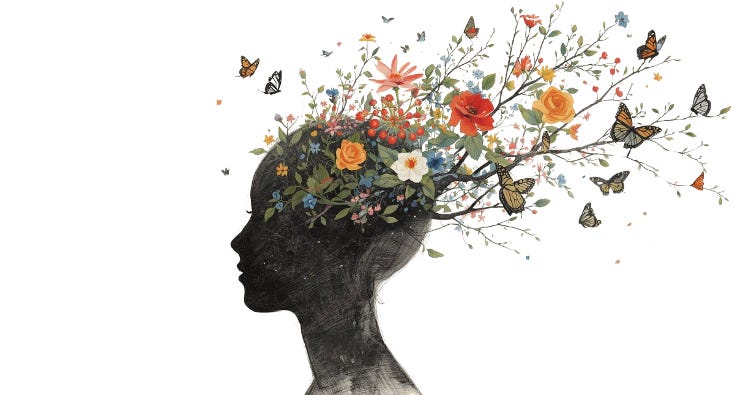
“What exactly do we mean by flourishing?”
It’s a fair question.
Human flourishing is a phrase we’re hearing more and more in education. It is also increasingly shaping strategic direction across schools and systems. And it matters, because it invites us to clarify what we value and what we’re designing for. The challenge (and opportunity) is making it concrete in the daily.
So perhaps we should begin by grounding it in what it truly means.
Eudaimonia (εὐδαιμονία) is the ancient Greek word often translated as “human flourishing.” It literally means “a state of good spirit,” but philosophically it describes something far richer: living in alignment with virtue, wisdom, and one’s highest nature. For Aristotle, it was not about feeling good. It was about living well (Aristotle, trans. 2009).
Not pleasure.
Not status.
Not performance.
But a life in which character, purpose, and contribution are cultivated over time.
That is where the contemporary language of “human flourishing” begins.
In recent years, the language of human flourishing has moved from the margins of philosophy into the centre of educational conversation. Across research, global policy, and school leadership networks, it is no longer peripheral. It is becoming a shared reference point, a way of describing what education is ultimately for.
That, in itself, feels significant.
When I listen to educators discuss and share deep thinking about flourishing, I don’t hear “add another programme.” I hear something quieter:
Name and focus on what matters most.
Notice what your community already does that supports it.
Design assessment, learning, and adult culture so that it grows over time.
I am wondering whether we are on the cusp of a renewed paradigm? Or are we being invited to notice the paradigm we are already inside and decide whether it still serves our young people?
A paradigm is the underlying logic that shapes what we value, what we measure, and what we design for, a framework of beliefs, assumptions, values, and practices that shapes how a field understands problems and solutions.
So when we talk about flourishing, we are really asking:
What is the purpose of education today?
How are we preparing our children to thrive in their future, not our past?
This Is Not a New Idea. But Something Is Shifting.
Aristotle gave us eudaimonia.
Centuries later, Amartya Sen (1999) and Martha Nussbaum (2011) reframed the conversation with a deceptively simple question:
What is a person genuinely able to be and do?
Not what score did they achieve.
Not how efficiently can they perform a task.
But what real freedoms and capabilities do they possess? Are they living well?
This question invites us to reflect on how performance systems and flourishing ambitions can better align.
Flourishing as “Living Well”
Tyler J. VanderWeele, Professor at Harvard University, reviewed decades of longitudinal and experimental research across psychology, sociology, economics, and public health to examine what genuinely contributes to a good life (VanderWeele, 2017).
His work sought to bring coherence to fragmented measures of wellbeing.
Across disciplines, he found that flourishing is not reducible to happiness alone. It involves doing or being well across at least five broad domains:
Happiness and life satisfaction
Mental and physical health
Meaning and purpose
Character and virtue
Close social relationships
Each of these domains, he argues, is generally regarded as an end in itself and nearly universally desired (VanderWeele, 2017).
Importantly, the strongest predictors of sustained flourishing were not momentary emotional states. Rather, they were participating in stable life structures, family, work, education, and community contexts in which individuals are embedded in meaningful roles, responsibilities, and enduring relationships.
People thrive less because of passing feelings and more because they belong somewhere meaningful.
More recently, this work has expanded into the Global Flourishing Study, a large-scale, multi-country longitudinal research project tracking over 200,000 participants across cultures (VanderWeele et al., 2023). The study now examines flourishing across six domains, adding financial and material stability to the earlier five.
It asks:
To what extent are individuals in different nations flourishing?
What factors influence flourishing in each country?
The OECD Shift: From Human Capital to Human Flourishing
In 2025, the OECD released Education for Human Flourishing: A Conceptual Framework, developed with engagement from high-performing systems including Estonia, Singapore, Finland, British Columbia, the United Kingdom, Germany, and Australia (OECD, 2025).
The framework presents flourishing as an integrated architecture.
At the base sit foundational conditions:
Foundational literacies (reading, mathematics, science)
Social and emotional skills
Well-being factors
These are not optional extras. They are the ground.
Above this foundation sit five interrelated competencies:
Adaptive problem-solving
Ethical competence
Understanding the world
Appreciating the world
Acting in the world
“Acting in the world” draws together the others, agency exercised with judgment.
At the top are the dimensions of flourishing itself:
Happiness
Relationships
Meaning
Accomplishment
Flourishing does not float free from rigour. It rests on knowledge. It integrates skills, values, and agency. And it ultimately aims at lives lived well, personally and collectively.
The shift is not away from standards. It is toward coherence.
AI only sharpens the conversation. If routine tasks are increasingly automated, then distinctly human capacities matter more:
Judgement.
Ethical reasoning.
Creativity.
Collaboration across differences.
Meaning-making.
Agency exercised within the community.
Literacy and numeracy remain essential, not as endpoints, but as enablers of adaptive thinking and contribution (OECD, 2025).
The opportunity before schools is not to soften expectations.
It is to align rigour with capability.
Lessons from Estonia and Singapore: Naming the Tensions
In an OECD panel discussion, Kristina Kallas, Estonia’s Minister of Education and Research, emphasised that flourishing begins with adults. Human flourishing does not grow in isolated career ladders but in collaborative professional cultures. AI, she suggested, can either erode agency or strengthen it; leadership determines which.
If we want students to develop agency, we cannot design systems that strip it from teachers.
Meanwhile, Liew Wei Li, Director-General of Education in Singapore, named a tension many leaders quietly recognise:
The curriculum is crowded.
Designing competencies is easy. Making space for them is hard.
Trade-offs are unavoidable.
Flourishing requires prioritisation.
And prioritisation requires courage.
What International Leaders Are Wrestling With
In a recent virtual roundtable hosted by the JUMP! Foundation, three international leaders reflected on what flourishing looks like when it moves beyond theory and into the lived experience of schools:
· Fatma Odaymat, School Director, Al-Rayan International School
· Marta Medved Krajnovic, Head of School, Western Academy of Beijing
· Angela Mikel, Global Head of IB World Schools
What struck me first was how personal their definitions of flourishing were — and how quickly those personal stories became system questions.
Fatma described flourishing as something that grows when young people can identify who they are, what matters to them, and how their lives can have an impact. She returned to this repeatedly, schools should help students find purpose earlier, not “wait for university” to discover their passions. And she was candid about where schools are right now: we don’t fully have the answers, but we can create the conditions for inquiry, risk-taking, and growth.
Marta spoke about flourishing as being grounded, connected, and growing with others and the world around you. She also named a tension many educators feel: schools can’t treat flourishing as “the next new thing.” Her solution was practical and strategic: use flourishing as an umbrella concept, a way to connect what many schools have already prioritised, wellbeing, agency, learning that is joyful and purposeful, global citizenship, without turning it into another add-on. In her context at WAB, flourishing wasn’t presented as a new direction; it was framed as a thread through the school’s mission, values, and long-standing commitments.
Angela’s lens widened to the global moment. She described flourishing as a container for competencies, values, and skills, grounded in humanity and interdependence, and made more urgent by the world we’re navigating, global crises, complexity, and AI. She also connected flourishing to strategy at the IB level: flourishing is not just a concept being discussed; it’s being positioned as a design goal (“designing education for flourishing”), with specific capabilities in view (wellbeing, empathy, critical judgement, navigating complex systems, and continuous self-development). Her framing echoed what many leaders are feeling: this isn’t about adding softness to schooling, it’s about designing for what human beings will need to live and contribute well.
When asked what they would redesign, their answer was unanimous: assessment. Assessment can become “the tail that wags the dog.” If schools are evaluated primarily through grades and narrow outcomes, the system quietly teaches everyone what matters, regardless of what schools say they value.
Which raises the question:
What are we signalling, implicitly, about what matters?
Across contexts, the same design tensions recur:
Assessment reform.
Authentic experience.
Agency and personalised pathways.
None of these are new ideas. But they feel different today because leaders are naming, with more urgency, and it forces the uncomfortable (and necessary) system question:
If flourishing is the aim, what might we need to protect, strengthen, or redesign so it can grow over time?
We might begin by asking:
Are our foundations genuinely strong (literacies, wellbeing, relational trust)?
Where do students practise ethical judgement and adaptive problem-solving in real contexts?
How do we create space for agency, not simulation, but action?
Does our assessment system reflect what we say we value?
Are adults working in conditions that allow them to exercise professional judgement?
What would genuinely need to shift in our systems for flourishing to move beyond aspiration?
Where does flourishing already live in your context?
Where does it create tension?
What feels possible and what feels difficult?
What We Are Really Trying to Cultivate
If we follow this conversation back to its roots, flourishing is not a programme. It is a portrait.
A young person who lives in harmony with their inner guide acts with virtue and reason. Someone who develops excellence in character, contributes meaningfully to the community, and continues to grow in practical wisdom. Someone who fulfils their highest nature and expresses wisdom through action.
When framed this way, flourishing does not compete with academic excellence. It deepens it.
Literacy becomes a tool for meaning-making.
Knowledge becomes a foundation for wise action.
Perhaps this is why the urgency feels different. Because we are not simply refining systems.
We are shaping lives.
References
Aristotle. (2009). Nicomachean ethics (C. D. C. Reeve, Trans.). Hackett Publishing Company. (Original work published ca. 350 BCE)
Nussbaum, M. C. (2011). Creating capabilities: The human development approach. Harvard University Press.
OECD. (2025). Education for human flourishing: A conceptual framework. OECD Publishing.
Sen, A. (1999). Development as freedom. Oxford University Press.
VanderWeele, T. J. (2017). On the promotion of human flourishing. Proceedings of the National Academy of Sciences, 114(31), 8148–8156.
VanderWeele, T. J., et al. (2023). The Global Flourishing Study: Study design and initial findings. Harvard University Human Flourishing Program & Baylor University.